
Podcast advertising has grown from a niche experiment into one of the most dependable channels in digital media. Brands use it to reach engaged, hard-to-find audiences with messages that listeners actually hear from start to finish. This guide covers how podcast advertising works, who it reaches, the main ad formats, how to buy and measure it, and the practices that separate strong campaigns from forgettable ones.
What Is Podcast Advertising?
Podcast advertising is any paid message placed inside a podcast episode. Ads can be read by the host, produced as a separate commercial, or delivered as video in shows that publish on video platforms. Because listeners choose the shows they follow and often listen through headphones, podcast ads reach people in a focused, low-clutter environment that most other media can't offer.
Podcast advertising is one part of the wider audio market. If you are new to the category, start with our overview of what audio advertising is and how brands buy it.
How Big Is the Podcast Advertising Market?
According to the IAB/PwC Internet Advertising Revenue Report, U.S. podcast advertising revenue grew 17.6% in 2025 to $2.86 billion. That is roughly 27 times the $106 million the channel generated in 2015, and it has grown every year in between.
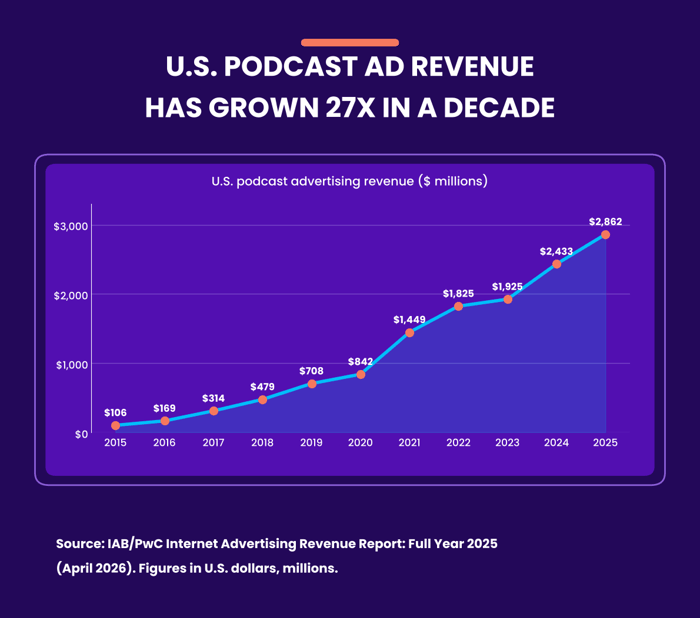
Source: IAB/PwC Internet Advertising Revenue Report: Full Year 2025
Who Listens to Podcasts?
The audience keeps expanding. Edison Research's Infinite Dial 2026 found that 58% of Americans age 12 and older listened to or watched a podcast in the last month, an estimated 167 million people and an all-time high.
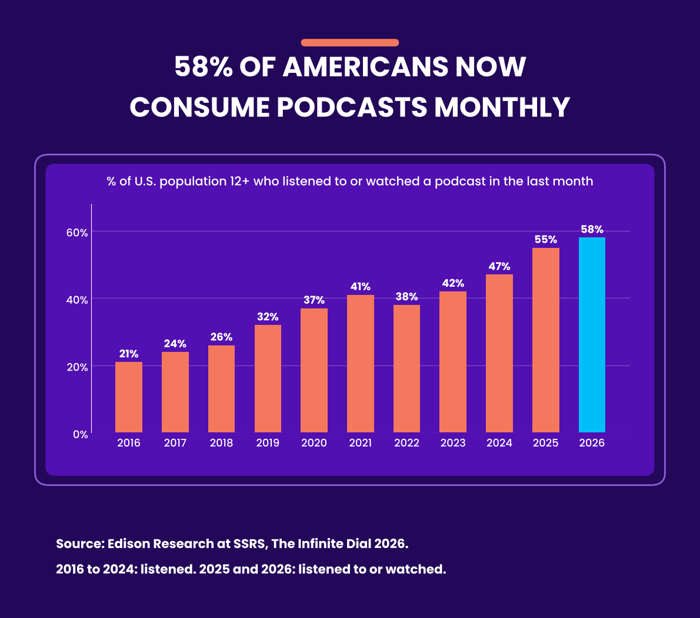
Source: Edison Research at SSRS, The Infinite Dial 2026
Triton Digital's 2025 U.S. Podcast Report adds detail on who these listeners are. They skew younger, more educated, more affluent, and more diverse than the general population. Most of them move between formats, too: among adults, 80% both listen to and watch podcasts, while about 13% only listen and 7% only watch.
Podcast Ad Formats
Host-Read Ads
The host reads the message in their own voice, often adding a personal story or endorsement. Host-read ads carry the trust listeners have in the show, which makes them the premium format for brand building and direct response alike.
Produced Spots
Produced spots are pre-recorded commercials, similar to radio ads. They give brands full control over the script and sound, and they scale easily across many shows at once.
Placement: Pre-Roll, Mid-Roll and Post-Roll
Pre-roll ads play before the episode starts, mid-roll ads play during a break in the content, and post-roll ads play at the end. Mid-roll usually commands the highest price because listeners are already engaged in the episode when the ad runs.
Video Podcast Ads
As more shows publish on video platforms, brands can add video placements and visual product integrations alongside traditional audio spots.
Baked-In Ads vs. Dynamic Ad Insertion
Baked-in ads are recorded directly into the episode file and stay there permanently. Dynamic ad insertion (DAI) places ads at the moment an episode is downloaded or streamed, so each listener can hear a different, targeted ad, and older episodes keep earning revenue. DAI also makes it possible to target by geography, device, time of day, and audience data. Our guide to dynamic ad insertion explains how it works for publishers.
How to Buy Podcast Ads
Direct With Shows and Networks
Brands and agencies can negotiate directly with a podcast network or an individual show. Direct deals are the usual route for host-read sponsorships, long-term partnerships, and premium placements.
Programmatically
Programmatic buying uses a demand-side platform (DSP) to purchase podcast impressions automatically, with consistent targeting and reporting across thousands of shows. The Triton Audio Marketplace gives buyers programmatic access to premium podcast, streaming, and broadcast radio inventory. For a step-by-step look, see our guide to programmatic advertising on podcasts, and for a side-by-side view of every buying route, read 5 ways to buy podcast ads.
How Podcast Ads Are Priced
Most podcast ads are priced on a cost-per-thousand-impressions (CPM) basis, while some host-read sponsorships are sold at a flat rate per episode. Rates vary with show size, genre, audience, ad format, and placement, with host-read mid-rolls typically at the top of the range.
How Podcast Advertising Is Measured
Reliable measurement is what gives buyers confidence. Podcast downloads are measured against the IAB Tech Lab Podcast Measurement Technical Guidelines, which filter out bots and duplicate requests so numbers can be compared across publishers. Triton's IAB-certified Podcast Metrics applies those standards, and Triton's Podcast Rankers show which shows and networks lead in downloads each month. Many brands also use attribution studies to connect ad exposure with site visits and purchases.
That attention translates into action. Triton's 2025 report found that new podcast listeners show stronger purchase intent across several key brand categories, according to the report announcement.
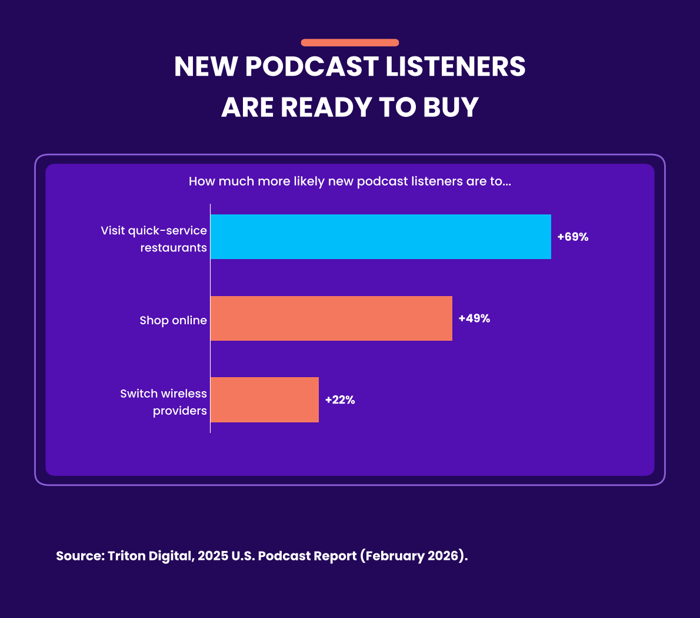
Source: Triton Digital, 2025 U.S. Podcast Report
Podcast Advertising Best Practices
- Match the show to the audience, not just the topic. Use audience and demographic data to find shows whose listeners fit your customer, even outside your category.
- Let hosts speak naturally. Give hosts key points instead of a rigid script so the read sounds genuine.
- Buy enough frequency. One mention rarely moves the needle. Plan for repeated exposure across several episodes.
- Use a clear call to action. A vanity URL or promo code makes response easy to track.
- Combine direct and programmatic. Pair premium sponsorships with programmatic reach to scale efficiently.
Getting Started
Podcast advertising reaches a large, growing, and highly engaged audience, and it can now be bought and measured with the same precision as other digital channels. Triton Digital supports the full podcast ecosystem, from hosting with Omny Studio to certified measurement and programmatic buying.
Ready to add podcasts to your media plan? Contact us at marketops@tritondigital.com to learn more.
