
Audio is one of the fastest-maturing channels in digital media, and the number of ways to buy it has grown just as fast. Picking the right audio advertising platform determines which audiences you can reach, how precisely you can target them, and whether you can prove the results. This guide walks through ten questions to ask before you commit budget to any platform.
Why Your Choice of Platform Matters
Spend on audio keeps climbing. The IAB/PwC Internet Advertising Revenue Report found that U.S. digital audio ad revenue reached a record $8.4 billion in 2025, up 10.2% from the year before and up from $4.9 billion in 2021.
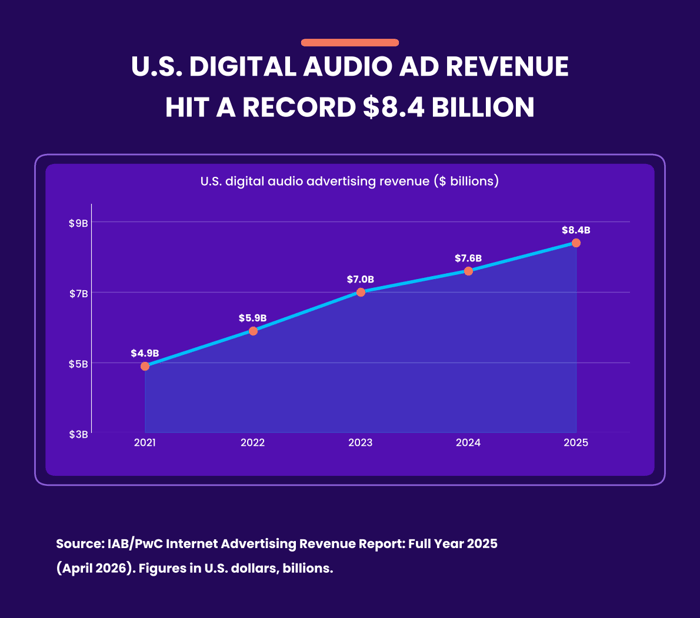
Source: IAB/PwC Internet Advertising Revenue Report: Full Year 2025
As more budget moves into audio, the gap widens between platforms that offer real scale, quality, and measurement and those that don't. If you are still mapping the basics, start with our overview of what audio advertising is and how brands buy it. Then use these ten questions to compare your options.
1. Which Audio Channels Can I Reach?
Listeners move between streaming music, podcasts, and AM/FM radio throughout the day, and the best platforms let you follow them across all three. The car shows how fast habits are shifting: according to Edison Research's Infinite Dial 2026, the share of U.S. drivers who use online audio in their car rose from 21% in 2016 to 48% in 2026, while AM/FM radio still reaches 73%.
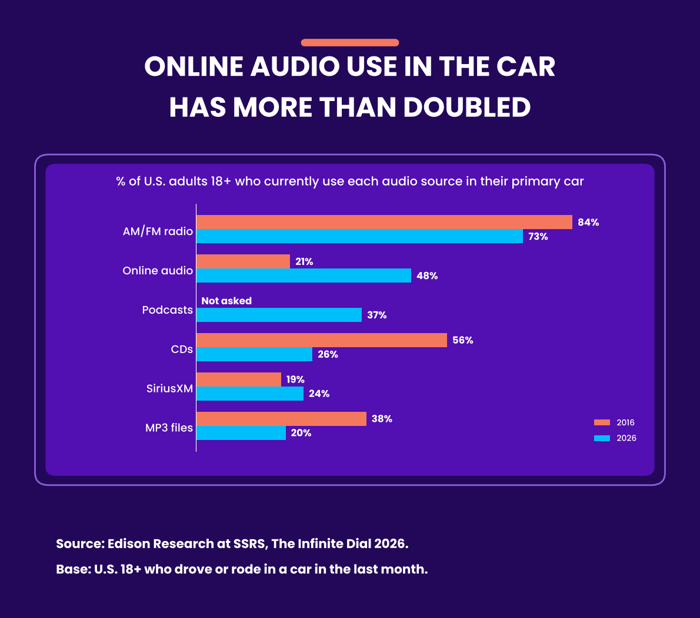
Source: Edison Research at SSRS, The Infinite Dial 2026
A platform limited to one channel forces you to run separate campaigns, with separate reporting, to reach the same person.
2. How Much Premium Inventory Does It Offer, and From Whom?
Audio listening is spread across many services. The same Infinite Dial study found that even the most-used online audio brand reaches only about a third of Americans (36%) in a given month.
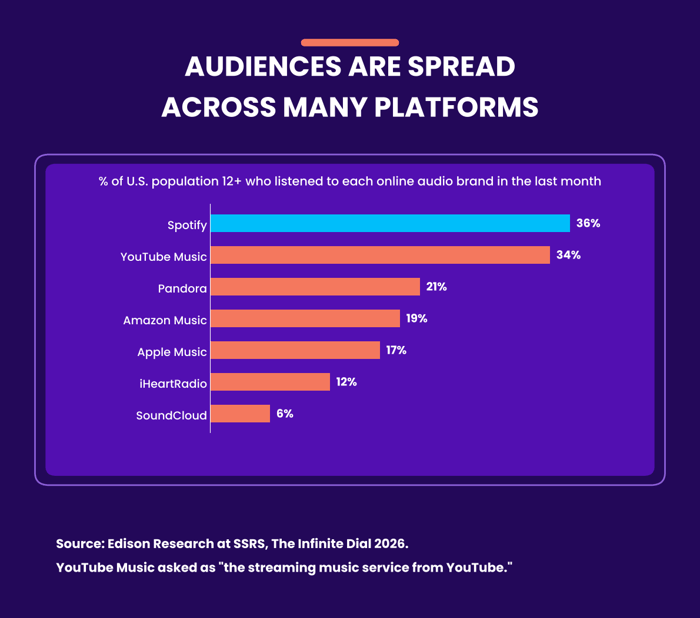
Source: Edison Research at SSRS, The Infinite Dial 2026
That makes aggregation essential. Ask which publishers a platform works with, whether the inventory is premium and brand-safe, and how many monthly impressions it can actually deliver against your audience. The Triton Audio Marketplace, for example, aggregates broadcast radio, podcast, and streaming audiences from top-tier publishers in one place.
3. Does It Work With the DSP I Already Use?
If your team buys programmatically, you shouldn't need a new login and workflow just for audio. Check whether the platform's inventory is available in your existing demand-side platform, so audio sits alongside display, video, and CTV in one plan. Triton publishes its list of DSP integrations for exactly this reason.
4. Which Deal Types Are Available?
Look for flexibility. Open auctions offer reach and efficient pricing, private marketplaces give access to selected publishers, and programmatic guaranteed deals lock in price and volume. A platform that supports all three lets you balance scale and control. Our guide to programmatic advertising on podcasts explains how these deals work in practice.
5. What Targeting Options Does It Support?
At minimum, expect targeting by geography, device, time of day, content genre, and audience data. More advanced platforms add contextual targeting based on what is actually being said in a podcast or stream. Sounder, Triton's AI-powered audio intelligence platform, analyzes podcast content at the topic level to support contextual targeting, brand safety, and brand suitability.
6. How Does It Handle Privacy and Consent?
Privacy rules keep tightening, and audio campaigns need to hold up under them. Ask how the platform collects and honors consent, and how well its targeting performs without personal identifiers. Our article on privacy-first targeting covers what to look for.
7. Is Its Measurement Independent and Certified?
Numbers you can't trust are worse than no numbers. For podcasts, ask whether downloads and impressions are measured against the IAB Tech Lab Podcast Measurement Technical Guidelines. Triton's IAB-certified Podcast Metrics gives buyers and sellers a common, audited currency.
8. What Brand Safety and Suitability Controls Does It Offer?
Brands need to know their ads won't run next to content that conflicts with their values. Look for category-level exclusions, adjustable risk thresholds, and transparency about where ads actually ran. In podcasts, where hosts speak freely for an hour or more, show-level genre labels are not enough. The strongest platforms classify content at the episode or even segment level, so you can avoid risky topics without cutting out large amounts of safe, high-quality inventory.
9. What Reporting and Attribution Will I Get?
Delivery reports are table stakes. Ask about reach and frequency, completion rates, and attribution studies that connect ad exposure to site visits, app installs, or sales. On the programmatic side, understanding metrics like delivery rate helps explain the gap between auction wins and delivered impressions.
10. What Creative Formats and Support Are Available?
Check which ad lengths, formats, and specs the platform accepts, whether it supports companion banners or video in video podcasts, and whether it can deliver dynamic or personalized creative. Standards such as the IAB Tech Lab's VAST, which added audio ad support in version 4.1, make it easier to run one creative across many publishers. For writing tips, see our best practices for creating effective digital audio ads.
Putting It All Together
The right audio advertising platform combines broad, premium reach across streaming, podcasts, and radio with flexible buying, strong targeting, certified measurement, and solid brand safety controls. Use these ten questions to compare platforms side by side before you sign anything.
To see how buyers and publishers use Triton Digital's digital audio advertising solutions, from the Triton Audio Marketplace for buyers to the Triton Ad Platform (TAP) for publishers, contact us at marketops@tritondigital.com.
